
Year 4
Welcome to Year 4!
Working with the children in Year 4 are:
4PB Class Teacher: Mrs Ballinger - pballinger@redhill.worcs.sch.uk
Supporting Staff: TBC
4EG Class Teacher: Mx Green - egreen@redhill.worcs.sch.uk
Supporting Staff: Mrs Ezzaquany
Year 4 Information:
Below you will find some key information about life in Year 4. This includes the important skills your child will be developing, the enrichment opportunities they will experience, and other useful details about their time with us this year. We hope this gives you a clear picture of what to expect and how we will be supporting your child’s learning and wellbeing.
To help you further, we’ve also included additional documents at the end of this section. These provide more detail about our curriculum and offer ideas about how you can support your child’s learning at home.
Autumn Term
English Writing Text 1: After the Fall
Purpose: To persuade
This term, we will begin by exploring the inspiring picture book After the Fall by Dan Santat. The story follows Humpty Dumpty as he learns to overcome his fears after a life-changing accident. Using this text as inspiration, children will write a persuasive speech to encourage Humpty Dumpty to climb again.
To develop their persuasive writing skills, children will practise:
- Using rhetorical questions to engage and influence the audience.
- Repeating key ideas for emphasis and impact.
- Selecting a wide range of powerful verbs and adverbs.
- Using emotive language to appeal to the audience's feelings.
- Organising ideas into clear and logical paragraphs.
Through this unit, children will learn how persuasive language can influence others while developing confidence in expressing their own opinions effectively.
English Writing Text 2: Beowulf
Purpose: To entertain
Building on their storytelling skills, children will explore the legendary tale of Beowulf. This exciting text will inspire children to write their own "overcoming the monster" stories for a young audience.
To develop their narrative writing, children will learn how to:
- Describe a heroic character in detail.
- Create an effective villain using powerful description.
- Plan and write a quest story in which the hero defeats a monster.
- Use fronted adverbials to describe when and how events occur.
- Organise writing into paragraphs that follow events in chronological order.
- Use direct speech accurately with inverted commas.
- Include expanded noun phrases to develop descriptions of characters and settings.
This unit will encourage children to use their imagination while developing key narrative writing skills.
English Writing Text 3: Into the Woods
Purpose: To entertain
In this unit, children will explore Into the Woods, using the text as inspiration to create vivid and engaging setting descriptions. They will focus on bringing woodland settings to life through carefully chosen vocabulary and descriptive techniques.
To develop their descriptive writing skills, children will learn how to:
- Use expanded noun phrases to describe settings in detail.
- Select adverbs to add further detail and precision.
- Use coordinating and subordinating conjunctions to link ideas effectively.
- Include similes and personification to create powerful imagery.
- Use nouns and pronouns accurately to ensure clarity and cohesion throughout their writing.
Through this unit, children will develop their ability to paint pictures with words, helping readers to imagine and experience the setting they have created.
Real Life Context Writing: Letter to Ms Simmonds
Purpose: To inform Audience: Headteacher
In this writing unit, children will write a formal letter of complaint to Ms Simmonds, our Headteacher. They will learn how to communicate their concerns clearly and respectfully while using appropriate formal language.
Children will develop the following skills:
- Setting out a letter correctly, including the sender's and recipient's addresses.
- Using paragraphs and subheadings to organise information effectively.
- Writing an introductory paragraph explaining the reason for the letter.
- Grouping ideas together in a logical sequence.
- Using expanded noun phrases to add detail.
- Including facts to strengthen and support their points.
- Using relative clauses to provide additional information.
- Linking ideas with conjunctions.
- Choosing rich vocabulary to create a formal tone.
- Using adverbials followed by commas.
- Applying apostrophes for possession accurately.
Through this real-life writing opportunity, children will develop their ability to communicate information effectively and understand the features of formal letter writing.
English Writing Text 4: How Santa Really Works
Purpose: To explain
Later in the term, children will study How Santa Really Works and use the text as a model for writing explanation texts. They will write an explanation describing how toys are made, learning how information texts are organised and presented.
To develop their explanation writing skills, children will learn how to:
- Use headings and subheadings written as questions.
- Write an introductory paragraph explaining the purpose of the text.
- Organise ideas into paragraphs in chronological order.
- Include diagrams and photographs to provide additional information.
- Use expanded noun phrases to add detail and precision.
This unit will help children develop their ability to communicate information clearly and logically while understanding the features of effective explanation texts.
Maths
At Year 4, we aim to develop confident, curious and resilient mathematicians. Children build their fluency with key mathematical skills while learning to reason, explain their thinking and solve a wide range of problems. Through practical activities, discussion and investigation, pupils develop a secure understanding of mathematical concepts and learn how to apply their knowledge in a variety of real-life contexts.
Place Value
Children will build a secure understanding of numbers up to 10,000. They will learn to read, write, represent and partition 4-digit numbers, compare and order numbers, identify 1, 10, 100 and 1,000 more or less, and round numbers to the nearest 10, 100 and 1,000. They will also be introduced to Roman numerals up to 100. Throughout the unit, children will explain their reasoning and apply their understanding through a range of problem-solving activities.
Addition and Subtraction
In this unit, children will develop confidence when adding and subtracting numbers with up to four digits using both mental and written methods. They will practise column addition and subtraction, including exchanging where appropriate, estimate and check their answers, and solve increasingly complex word problems. There will be a strong emphasis on choosing efficient strategies and explaining mathematical thinking.
Length and Perimeter
Children will explore different units of length and learn to convert between kilometres and metres. They will measure and compare lengths, calculate the perimeter of rectangles, rectilinear shapes and polygons, and find missing side lengths. Throughout the unit, children will apply their understanding to a range of reasoning and problem-solving activities.
Multiplication and Division
Children will build fluency with multiplication and division by learning and applying the 3, 6, 7, 9, 11 and 12 times tables and their related division facts. They will use known facts to solve new calculations, explore patterns within multiplication, develop efficient mental strategies and apply their knowledge to reasoning and problem-solving tasks. Children will also investigate multiplying by 0 and 1, dividing by 1 and by itself, and multiplying three numbers together.
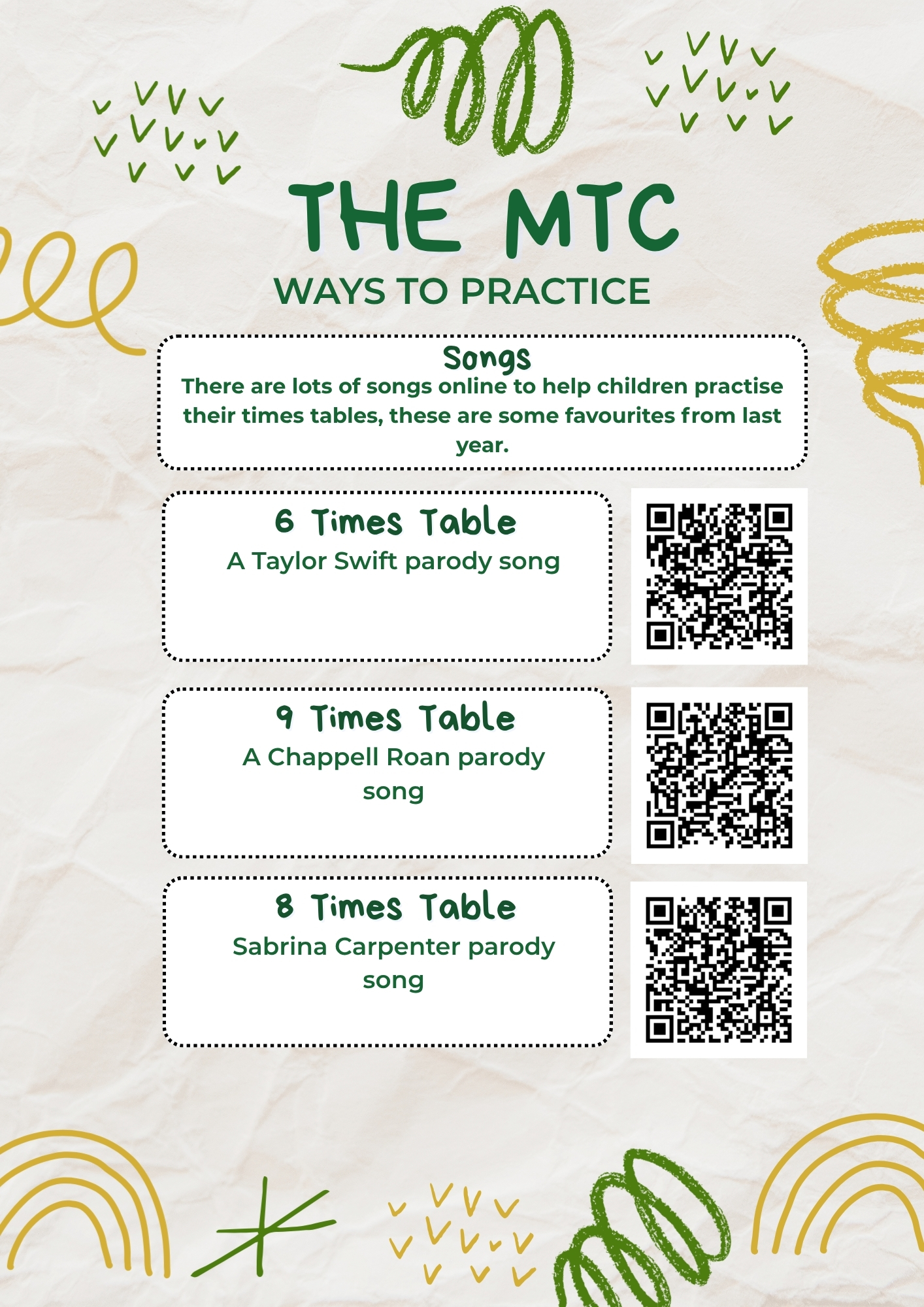
MTC check for Year 4 - Summer Term


Guided Reading
This term, our whole-class guided reading sessions will focus on two engaging and thought-provoking texts: Kensuke's Kingdom by Michael Morpurgo and There's a Boy in the Girls' Bathroom by Louis Sachar. These texts provide exciting opportunities to develop reading comprehension skills while exploring important themes and character development.
Text 1 – Kensuke's Kingdom
In our first guided reading text, children will read and discuss Kensuke's Kingdom, an adventurous story about survival, friendship and resilience. Children will:
- Develop retrieval and inference skills by exploring characters' thoughts, feelings and actions.
- Summarise key events and identify how the plot develops throughout the story.
- Explore themes such as friendship, courage, loneliness and survival.
- Discuss the author's use of descriptive language to create setting and atmosphere.
- Make predictions using evidence from the text.
Text 2 – There's a Boy in the Girls' Bathroom
Our second guided reading text is There's a Boy in the Girls' Bathroom, a humorous and heart-warming story about friendship, self-belief and personal growth. Through this text, children will:
- Build empathy by considering characters' emotions, relationships and choices.
- Develop inference skills by justifying ideas with evidence from the text.
- Explore how characters change and develop throughout the story.
- Discuss themes such as friendship, kindness, confidence and belonging.
- Extend vocabulary through the exploration of language and authorial choices.
Across both texts, guided reading will enable children to read with increasing fluency and expression, engage in thoughtful discussion, and develop a deeper understanding of how books can help us explore different experiences, emotions and perspectives.
Religious Education
Our key question for Autumn 1: What do Hindus believe God is like?
Children will explore Hindu beliefs about God and learn how Hindus understand one supreme divine reality, Brahman, which can be represented in different forms, including deities such as Vishnu, Shiva and Lakshmi. They will investigate Hindu stories, symbols and worship, considering how beliefs about God influence the lives of Hindu people.
Our key question for Autumn 2: What does it mean to be Hindu in Britain today?
Children will learn about the everyday lives of Hindus living in Britain and explore how Hindu beliefs are expressed through worship, festivals, traditions and family life. They will investigate the importance of the home, the mandir, prayer, and celebrations such as Diwali, while considering how faith helps to shape identity and belonging.
Through these themes, children will develop their understanding of Hindu beliefs and practices whilst reflecting on values such as respect, community and devotion.
Science
Autumn 1 – How do I digest my food?
Children will learn about the human digestive system and the important role it plays in helping our bodies obtain nutrients from food. They will explore the journey food takes through the body, identifying the functions of the stomach, small intestine, large intestine and rectum. Children will also investigate the different types of human teeth, including incisors, canines and molars, and understand how each is adapted for a specific purpose in the process of digestion.
Autumn 2 – How does sound travel?
Children will investigate how sounds are made and how they travel. They will learn that sound is created by vibrations and that these vibrations travel through different materials to reach our ears. Through practical investigations, children will explore how pitch and volume can change, how musical instruments produce sound, why some materials are better at blocking sound than others, and how sound becomes quieter as the distance from the source increases.
History and Geography
History – Autumn 1
What can we learn about the Anglo-Saxons from what we see today?
This term, children will explore the fascinating world of the Anglo-Saxons and discover how evidence from the past helps us learn about their lives. They will investigate important archaeological discoveries, including Sutton Hoo, and examine what these reveal about Anglo-Saxon society. Children will learn about Anglo-Saxon homes, daily life and farming, explore how kingdoms were ruled, and discover how many words and place names used today have their roots in Anglo-Saxon traditions.
Geography – Autumn 2
How do rainforests and deserts differ?
Children will explore the world's major biomes and compare the features of rainforests and deserts. They will learn about the location of the Equator and the Tropics of Cancer and Capricorn, and investigate how climate affects different environments around the world. Children will discover why rainforests are found near the Equator, why deserts are commonly located near the tropics, and learn about the different layers of the rainforest, including the emergent layer, canopy, under-canopy and shrub layer. Through this unit, they will develop their understanding of how physical geography shapes the world's environments.
Art and DT
Autumn 1 Art – Welcome to the Jungle
Children will explore the work of Henri Rousseau and use rainforest environments as inspiration for their own artwork. They will learn how artists create texture through layering and experiment with a range of media, including paint, pastels and collage. Children will develop their understanding of colour by creating tertiary colours and exploring hue, while also learning how proportion and scale help to make animals and objects appear realistic within a composition.
Autumn 2 DT – Cooking Bolognaise
Children will investigate healthy eating and learn how to prepare and cook a balanced bolognaise meal. They will explore the ingredients needed for a healthy diet, using the Eatwell Plate as a guide, and develop practical food preparation skills, including using the ‘claw’ grip safely when cutting vegetables. Children will learn about food hygiene, preventing cross-contamination, following recipes and adapting existing meal ideas to create their own designs.
PE for Autumn Term 1
Outdoor PE will take place on Thursday and children will be learning Netball. Please ensure your child comes to school wearing appropriate outdoor PE kit suitable for the weather conditions.
Swimming will replace indoor PE and will take place on Friday mornings at Perdiswell Leisure Centre. Children will swim from 10:00am to 10:30am. The coach will leave school promptly at 9:25am and return at approximately 11:20am.
Swimming dates:
September 2026: 11th, 18th, 25th
October 2026: 2nd, 9th, 16th, 23rd
November 2026: 6th, 13th, 20th
Please note:
- If your child has a verruca, please provide a specialist verruca sock.
- Please ensure that all clothing and towels are clearly named.
- Children with hair longer than ear length must wear a swimming hat.
- Girls should wear a one-piece swimsuit and boys should wear swimming trunks (not shorts).
- Children may wear their swimwear underneath their school uniform on Friday mornings.
- Earrings may not be worn in the pool. If earrings cannot be removed due to a recent piercing, they must be covered with tape.
- Children will be assessed during their first swimming session and grouped according to ability.
Enrichment opportunities
Children will also take part in weekly swimming lessons on Friday mornings, developing their confidence, water safety awareness and swimming skills. Please see the PE section for further information regarding swimming arrangements.